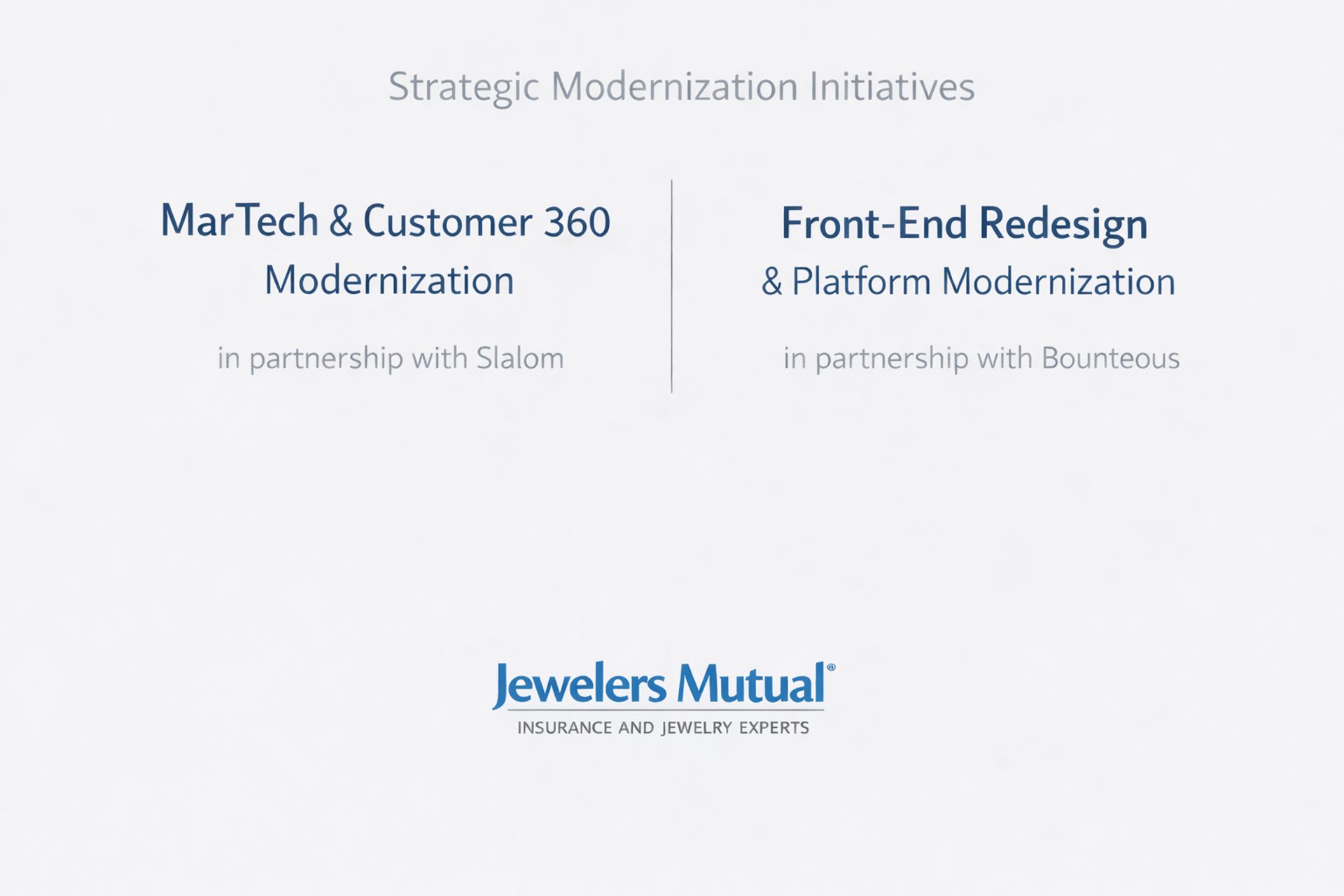
At Jewelers Mutual Insurance Company, I partnered with Slalom to conduct a comprehensive MarTech assessment—mapping every customer‑facing technology integration and identifying gaps—and then developed a high‑level, three‑year strategic roadmap to build a true Customer 360 platform with unified data models, API frameworks, personalization strategies, and governance standards. At the same time, I worked with Bounteous to craft a frontend strategy—defining a mobile‑first, component‑based architecture, performance budgets, user‑experience guidelines, and API consumption patterns—ensuring that the future site would seamlessly leverage our Customer 360 foundation.
MarTech-Initiative Goals
Assess & Map Current Stack
Catalog all existing customer‑facing technologies, data sources, and integrations to identify gaps, redundancies, and maturity levels.Define Customer 360 Data Model
Specify a unified schema that consolidates policyholder attributes, engagement history, and AI‑rating feeds into a single customer‑data platform blueprint.Establish API Framework & Security
Develop standardized API specifications, access controls, and security protocols to expose Customer 360 data for real‑time personalization and testing.Develop Personalization & Testing Strategy
Outline use cases for dynamic content, segment definitions, and A/B/multivariate testing—ensuring all campaigns leverage the unified data model.Build a Roadmap
Sequence major MarTech milestonesImplement Governance & Operating Model
Define roles, decision rights, change‑control processes, and data‑quality standards to manage the MarTech platform sustainably.Specify Success Metrics & Dashboards
Identify KPIs (e.g., data completeness, API uptime, personalization lift, campaign ROI) and outline requirements for Power BI dashboards to monitor ongoing performance.Engage Stakeholders & Secure Sponsorship
Align executive sponsors, marketing, IT, and compliance teams to validate goals, resolve dependencies, and ensure resource commitments.
Frontend-Initiative Goals
Assess & Audit Current Site
Inventory existing frontend technologies, frameworks, and performance baselines to identify strengths, weaknesses, and technical debt.
Define Mobile‑First, Component‑Based Architecture
Specify a modular UI framework with reusable components, responsive design patterns, and performance budgets to ensure consistency and scalability.
Design UX & Interaction Guidelines
Develop wireframes, style guides, and interaction specifications that prioritize usability, accessibility (WCAG 2.1), and brand alignment.
Integrate Customer 360 APIs
Outline requirements and data contracts for consuming MarTech APIs—customer segments, personalization rules, and A/B test variants—within frontend components.
Establish Frontend Performance & Accessibility Standards
Define target metrics (e.g., first contentful paint, time to interactive) and accessibility criteria, and document testing protocols using automated tools.
Develop Testing & Deployment Strategy
Specify unit, integration, and end‑to‑end test requirements; outline CI/CD pipelines, feature‑flag controls, and rollback procedures.
Implement Governance & Release Cadence
Define roles, decision‑rights, and sprint cadence for frontend development; establish code‑review, merge‑request, and release‑management processes.
Specify Success Metrics & Monitoring
Identify key KPIs (page‑load times, mobile engagement, accessibility scores, error rates) and outline requirements for dashboards in Power BI or equivalent.
Summary
Project Teams
MarTech Mastery
Established a Steering Committee composed of:
Chief Operating Officer serving as Executive Sponsor
Chief Information Officer providing enterprise architecture and security oversight
Senior Vice President of Marketing driving customer strategy and personalization objectives
I facilitated executive reviews to secure roadmap approval, resolve dependencies, align funding, and track performance against defined KPIs. This structure ensured the initiative remained business-led while technically sound.
Strategic Roadmap Development – Slalom Partnership
I partnered with Slalom as our strategic MarTech advisory firm to conduct a current-state assessment and assist in building the phased Customer 360 roadmap.
In collaboration with Slalom and executive leadership, I:
Led workshops to assess existing technologies, data maturity, and integration gaps
Defined future-state capabilities aligned to personalization and analytics goals
Sequenced roadmap milestones across foundational data consolidation, API enablement, and personalization rollout
Incorporated industry benchmarks and best-practice frameworks into the operating model
While Slalom supported roadmap development and strategic advisory, I retained execution ownership and ensured internal teams were aligned to deliver against the phased plan.
Core Delivery Structure
To operationalize the strategy, I aligned a cross-functional team consisting of:
Marketing Team – 6 Personnel
Focused on segmentation strategy, campaign activation, personalization logic, and performance measurement.
IT Team – 4 Personnel
Responsible for enterprise architecture, API design, data integration, cybersecurity controls, and platform reliability.
Cross-Functional Business Representatives – 14 Personnel
Representing underwriting, operations, claims, compliance, analytics, and other business units.
These stakeholders validated requirements, supported UAT, and ensured operational adoption.
Enterprise Stakeholder Engagement
I engaged all Department Heads across Lines of Business to:
Validate initiative priorities
Confirm resource commitments
Align personalization use cases to revenue objectives
Ensure adoption planning across impacted teams
This stakeholder alignment minimized resistance and strengthened executive sponsorship.
I facilitated working sessions, managed RAID logs, and maintained alignment between business objectives and technical delivery milestones.
Governance & Operating Model Impact
As Program Manager, I ensured the initiative delivered:
• Clear executive sponsorship and decision-right clarity
• Defined separation between strategic advisory and execution accountability
• Integrated Marketing and IT ownership
• Structured delivery cadence with measurable KPIs
• Roadmap-driven transformation tied to business outcomes
This governance model positioned the MarTech initiative as an enterprise digital transformation effort rather than a standalone marketing project.
Digital Transformation Strategy Team
Parallel Modernization Initiatives Driving a 3-Year Digital Strategy
At Jewelers Mutual, I managed two parallel enterprise initiatives:
MarTech & Customer 360 Modernization
Front-End Redesign & Platform Modernization
Although executed as separate projects with independent governance, these initiatives were strategically aligned. Together, they established the foundational capabilities that directly informed and shaped the organization’s 3-Year Digital Transformation Strategy.
Project 1: MarTech & Customer 360 Modernization
Strategic Objective
Modernize the marketing technology ecosystem and establish a unified Customer 360 data foundation capable of supporting personalization, experimentation, and enterprise analytics.
Key Components
Current-state MarTech assessment in partnership with Slalom
Design of unified Customer 360 data architecture
API-first integration standards
Enterprise segmentation and experimentation framework
Governance model and KPI dashboard strategy
Strategic Contribution
This initiative defined the long-term data intelligence roadmap and clarified the sequencing required to achieve advanced personalization maturity over a multi-year horizon.
It became the data and intelligence pillar of the 3-Year Strategy.
Project 2: Front-End Redesign & Platform Modernization
Strategic Objective
Modernize the digital experience platform and prepare the architecture for scalable personalization and content orchestration.
Key Components
Transition from tightly coupled straight-through architecture to headless and hybrid model
API-first frontend orchestration aligned with Customer 360 integration
Evaluation and selection of a unified enterprise CMS
Standardization of enterprise digital data collection
Component-based design system and performance governance
Implementation support from Bounteous
Strategic Contribution
This initiative defined the scalable experience delivery framework required to operationalize Customer 360 capabilities.
It became the experience and delivery pillar of the 3-Year Strategy.
How the Parallel Projects Shaped the 3-Year Digital Strategy
Running these initiatives in parallel allowed the organization to:
• Validate architectural direction before enterprise-wide scaling
• Identify investment sequencing and funding priorities
• Establish API governance standards
• Define CMS consolidation strategy
• Clarify data maturity milestones
• Create measurable performance baselines
The insights, roadmaps, and governance structures developed within these projects were incorporated into a formal 3-Year Digital Strategy that included:
Year 1: Foundational modernization and architecture transition
Year 2: Personalization expansion and analytics maturity
Year 3: Optimization, automation, and scalable experimentation
Executive Governance Alignment
As these projects matured, governance expanded to include:
Executive Oversight
Chief Operating Officer
Chief Information Officer
Senior Vice President of Marketing
Vice President of Finance
Department Leadership Alignment
IT Department Heads
Marketing Department Heads
Data Department Heads
This evolved into a formal Digital Transformation Strategy Team responsible for long-term execution oversight.
Enterprise Impact
As Project Manager, I led two concurrent modernization initiatives that:
• Established enterprise Customer 360 capability
• Enabled transition to headless and hybrid architecture
• Consolidated to a unified CMS platform
• Standardized digital data collection
• Reduced technical debt and improved scalability
• Provided executive-level clarity for multi-year investment planning
These parallel efforts became the operational proof points and architectural foundation for Jewelers Mutual’s 3-Year Digital Transformation Strategy.
Front-End Redesign
Front-End Redesign & Digital Modernization
Jewelers Mutual
Project Manager Perspective
As the Project Manager at Jewelers Mutual, I led the enterprise Front-End Redesign initiative focused on modernizing the digital experience platform, unifying frontend services, and enabling Customer 360 integration. This initiative extended beyond a visual refresh and included architectural transformation, CMS consolidation, and standardized enterprise data collection.
Executive Governance & Oversight
I structured and facilitated executive oversight to ensure alignment across business, technology, finance, and architecture leadership. The Steering Committee included:
Chief Operating Officer serving as Executive Sponsor
Chief Information Officer providing enterprise technology and cybersecurity oversight
Senior Vice President of Marketing aligning customer experience and growth strategy
Vice President of Finance overseeing investment governance and ROI validation
Vice President of Architecture ensuring modernization standards and architectural integrity
I led recurring executive updates to track roadmap progress, manage enterprise risk, align funding decisions, and ensure delivery remained tied to measurable business outcomes.
Architectural Transition: Straight-Through to Headless & Hybrid
A core objective of the initiative was transitioning Jewelers Mutual from a tightly coupled straight-through architecture to a modern headless and hybrid model.
Legacy State
The previous frontend environment tightly coupled presentation, business logic, and backend services, limiting scalability, slowing release cycles, and constraining personalization capabilities.
Target State
While architecture design authority resided with the Architecture team, I managed the cross-functional planning, sequencing, and delivery required to implement:
Decoupled frontend presentation layers
API-first integration standards
Unified frontend orchestration across Lines of Business
Hybrid compatibility to maintain legacy system interoperability
Real-time consumption of Customer 360 APIs
This shift improved modularity, reduced technical debt, and enabled scalable personalization and experimentation capabilities.
Unified CMS Identification & Consolidation
The initiative included identifying and recommending a unified enterprise CMS to replace fragmented content management systems across digital properties.
I led:
Cross-functional requirements workshops with Marketing, IT, Compliance, and Architecture
Evaluation of CMS platforms based on headless capability, scalability, security, governance, and integration flexibility
Total cost of ownership analysis in partnership with Finance
Vendor coordination and proof-of-concept validation
Executive recommendation aligned to the phased modernization roadmap
The selected CMS supported headless deployment, API-driven content delivery, reusable components, and centralized content governance across Jewelers Mutual digital properties.
Enterprise Data Collection & Standardization
To support Customer 360 enablement and analytics maturity, I coordinated standardization of digital data collection practices.
This included:
Establishing enterprise tagging standards
Defining event tracking frameworks aligned to personalization goals
Integrating frontend data with Customer 360 pipelines
Coordinating privacy, compliance, and regulatory validation
Defining governance controls for data accuracy and completeness
This created a consistent data foundation supporting personalization, experimentation, and performance analytics.
Core Delivery Team
I aligned execution across:
Data & Front-End IT Department Head
Accountable for engineering performance and integration oversight.
Engineering Team
12 Developers responsible for componentization, CMS integration, API connectivity, and performance optimization
2 Architects responsible for solution design, scalability modeling, and security compliance
I facilitated sprint planning, managed RAID logs, maintained cross-functional alignment, and ensured release governance discipline.
Strategic Implementation Partner
Bounteous – Digital Experience & CMS Implementation Partner
I coordinated engagement with Bounteous to support:
Headless and hybrid architecture implementation
CMS configuration and integration
Component-based design system enablement
UX modernization aligned with accessibility standards
Performance optimization aligned to Core Web Vitals
While Bounteous provided digital acceleration expertise, I retained accountability for schedule adherence, dependency management, stakeholder communication, and executive reporting.
Initiative Impact at Jewelers Mutual
As Project Manager, I ensured the initiative delivered:
• Enterprise-wide unification of frontend services
• Transition to a headless and hybrid architecture
• Consolidation to a unified CMS platform
• Standardized digital data collection aligned to Customer 360
• Improved scalability and release predictability
• Personalization readiness across Lines of Business
• Executive visibility into modernization ROI
This transformation positioned Jewelers Mutual with a flexible, API-driven digital foundation capable of supporting long-term growth, personalization, and digital innovation.






3 Year Digital Transformation Strategy Smart Goals
Strategic Vision
Establish a unified, secure, and scalable digital ecosystem that integrates Customer 360 intelligence with a modern, mobile-first frontend platform to deliver real-time personalization, measurable business growth, and sustainable governance
Goal 1: Establish a Unified Customer 360 Data & API Foundation
Specific
Design and implement a governed Customer 360 architecture consolidating policyholder data, engagement history, behavioral signals, and analytics feeds into a single source of truth. Establish standardized API-first integration patterns with secure authentication and role-based access controls.
Measurable
100% inventory and rationalization of customer-facing data sources
Greater than 90% unified customer profile completeness
API uptime meeting enterprise SLA targets
Documented enterprise data governance standards adopted
Time-Bound
Foundational data model and API framework operational within Year 1.
Goal 2: Transition to Headless & Hybrid Digital Architecture
Specific
Shift from tightly coupled straight-through architecture to a headless and hybrid model that decouples frontend presentation from backend systems and enables API-first orchestration across Lines of Business.
Measurable
Decoupling completed across all customer-facing experiences
Reduction in release cycle time
Core Web Vitals compliance across digital properties
Customer 360 API consumption enabled across frontend services
Time-Bound
Core architecture transition completed within 18 months.
Goal 3: Implement Unified Enterprise CMS & Standardized Data Collection
Specific
Identify, evaluate, and implement a unified CMS supporting headless deployment, reusable component integration, centralized governance, and API-driven content delivery. Standardize digital tagging and event-tracking frameworks aligned to Customer 360 requirements.
Measurable
Decommission legacy CMS platforms
Centralize content governance under one enterprise platform
100% implementation of standardized tagging framework
Reduced content deployment time
Time-Bound
CMS selection within 6–9 months; phased rollout completed within 18 months.
Goal 4: Operationalize Personalization & Experimentation
Specific
Define enterprise segmentation standards and embed A/B and multivariate testing frameworks within frontend architecture and campaign lifecycle using Customer 360 data.
Measurable
Defined number of experiments launched quarterly
Measurable lift in engagement or conversion
Reduced campaign deployment lead time
Executive dashboards tracking personalization impact
Time-Bound
Framework operational by Year 2; measurable lift achieved within 24 months.
Alignment Confirmation
Connects Customer 360 foundation and headless frontend architecture into measurable business outcomes.
Goal 5: Enforce Enterprise Performance, Security & Accessibility Standards
Specific
Define and enforce digital performance benchmarks, API reliability standards, cybersecurity protocols, and WCAG 2.1 accessibility compliance across all digital platforms.
Measurable
API uptime meeting SLA
Accessibility compliance across properties
Reduced critical vulnerabilities
Improved mobile performance benchmarks
Time-Bound
Standards defined within 6 months; enterprise compliance achieved within 12–18 months.
Alignment Confirmation
Consistent with prior references to performance governance, API SLAs, and compliance alignment.
Goal 6: Establish Governance & 3-Year Digital Roadmap
Specific
Formalize cross-functional governance, decision rights, change-control processes, sprint cadences, CI/CD standards, and executive KPI dashboards. Develop and publish a phased 3-Year Digital Strategy sequencing:
Year 1 – Foundational architecture and CMS consolidation
Year 2 – Personalization expansion and analytics maturity
Year 3 – Optimization, automation, and scalable experimentation
Measurable
Approved and funded 3-Year roadmap
Quarterly executive reporting cadence
Improved release predictability
Executive dashboards tracking data completeness, personalization lift, performance, and ROI
Time-Bound
Roadmap approved within first 90 days; governance operational within 6 months.